Can you actually trade meme coins with a $10 bankroll and still come out ahead?
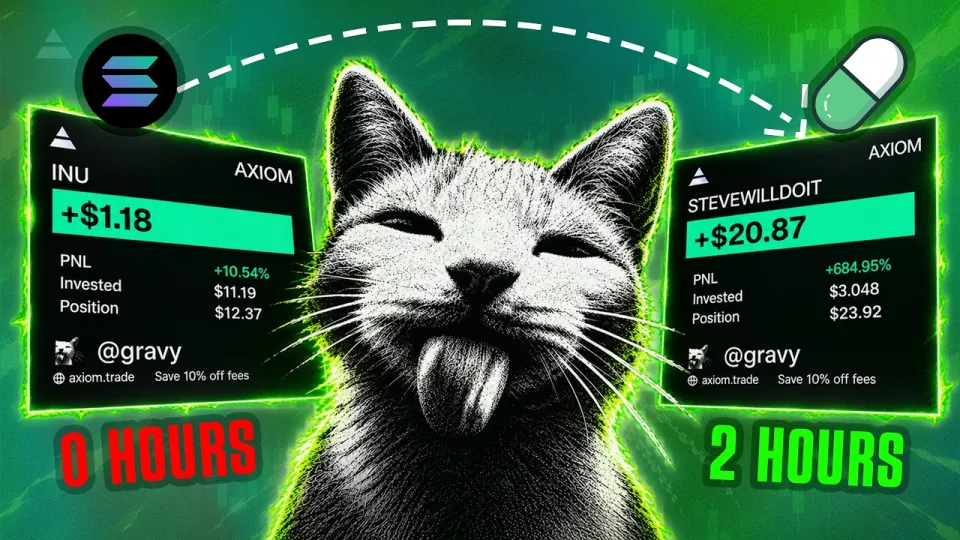
Video: I Tried Trading Memecoins with Just $10
You can order the same kind of articles for your own video to boost it on YouTube and Google. Just message the Telegram bot @sat_sit_bot. The bot writes and publishes the articles itself (with your YouTube video embedded) on popular topical websites (no ads). Try it free: 50 articles on us.
· based on the channel gravy
Meme coin trading with $10 is possible, but only if you treat the $10 as tuition rather than a portfolio: five Solana trades with buys under 0.05 SOL each can all be executed, and the outcome depends far more on picking narratives and exiting fast than on the starting balance. A small bankroll survives meme coins when every position is sized so that fees, priority tips and slippage cannot wipe it out in one mistake. The experiment is documented on the Axiom trading terminal the author uses, where the referral link gives cashback and a fee discount.
Small-account trading gets dismissed for a simple reason: on Solana, a swap can cost a fixed base fee plus a priority tip plus slippage plus the platform's own cut, and on a $2 position those costs are brutal in percentage terms. The counter-argument is that the skills — reading a narrative early, checking liquidity, taking profit into strength — are identical at $10 and at $10,000, and the $10 version is cheaper to learn on. That is the premise the gravy channel sets out to test.
Why a $10 meme coin portfolio is mostly a fee experiment
Every meme coin trade on Solana carries layered costs, and the smaller the position, the larger the share each one takes. The base network fee is trivial, but a priority fee to land the transaction, a swap fee from the aggregator or terminal, and the spread between quoted and executed price are not. On a 0.05 SOL buy, a few cents of friction is already a meaningful percentage of the position.
That produces three practical rules for low-balance trading:
- Keep the position large enough that fixed costs stay in single-digit percentages — under 0.01 SOL, fees dominate.
- Never split a tiny bankroll across many simultaneous positions; each extra trade adds another round of costs.
- Count the exit as part of the plan, because selling is a second full set of fees.
The honest conclusion is that a $10 account cannot be scaled into a meaningful portfolio through fee optimisation alone. What it can do is teach position sizing, execution speed and narrative timing at a price that does not hurt.
The five trades and what each one was really testing
The experiment ran five positions, each bought for no more than 0.05 SOL, and each chosen for a different reason rather than from a single screen. STEVEWILLDOIT was the first, a name built on a viral internet character; NPC followed as an AI-agent-adjacent meme; MET tied to Meteora, a Solana liquidity protocol; PUMPY the Trader leaned on the pump.fun launch culture; UNTXD was the last and least convincing entry.
The pattern is instructive. Four of the five were narrative trades — a story spreading on social feeds — rather than technical setups. That is how most meme coin profits are actually made: you buy attention before it peaks and sell into the crowd that arrives after you. The author also spends time on why the X Money coin meta ran, tying it to the e/acc and Cream crowd on X, which is a reminder that these narratives are social, not fundamental.
What the trades were not: long-term holds. Each one had a reason to exist and a reason to be sold, and the sell decision mattered more than the entry.
How to read a meme coin narrative before the crowd does
The edge in meme coins is timing a story, not valuing a business, and the practical version of that skill is a checklist rather than a feeling. Narratives run in waves: a theme gets traction, dozens of copycat tickers appear within hours, and only the first one or two attract real liquidity.
A workable filter looks like this:
- Identify who is amplifying the story. A theme pushed by accounts with a track record of moving attention behaves differently from one pushed by brand-new profiles.
- Check whether the ticker is the first of its theme or the tenth. Late copycats usually peak on launch.
- Look at liquidity and holder distribution before size, because a thin pool turns a small sell into a large drawdown.
- Decide in advance what invalidates the trade. If the story needs a new catalyst to keep going, the exit is the catalyst itself.
This is also the answer to the most common complaint from small traders: buying a dip and watching it never recover. In meme coins, a dip after the narrative peak is usually distribution, not opportunity, and the coin that "ran higher later" was often a different wave with a fresh catalyst.
Mistakes that hurt more than a small balance
The biggest damage in the experiment came from execution, not from the $10 ceiling. The author openly flags one trade he fumbled hard, and that is the most useful part of the review: a small account has no room for hesitation, because a delayed exit on a fast mover costs a larger share of the position than it would on a bigger book.
Recurring errors in low-balance meme coin trading:
- Chasing an entry after the move has already printed, which turns a planned trade into a hope trade.
- Averaging down into a broken narrative instead of accepting the loss and keeping the remaining balance.
- Forgetting that a 20–40% stop on a tiny position leaves almost nothing to compound.
- Overtrading, because each additional swap re-pays the full fee stack.
None of these are solved by adding capital. They are solved by writing the exit down before the buy and by accepting that a $10 account's realistic goal is a clean process, not a large profit.
What the audience keeps asking about small-account trading
The questions around this experiment cluster into a few practical themes: consistency, information overload, and whether a live session with a doxxed wallet would be more useful than an edited one. Several viewers wanted a final portfolio number, which is a fair point — the video walks through individual trades but does not close with a single total P&L figure, and that omission makes the result harder to judge.
Others described the real bottleneck: keeping up with which accounts matter, which themes are fresh, and when a dip is a buy. The honest answer is that this is a research workload, and most people lose money on meme coins because they arrive at the narrative late and leave after the drawdown. The author's own suggestion — running the next round live from 0.1 SOL or 1 SOL — would expose exactly that timing pressure, which is why the community pushed for it.
A practical middle ground for a beginner is to follow a small number of themes, keep a written journal of entries and exits, and size every trade so a total loss is survivable. That is a repeatable process, and it is the only part of meme coin trading that transfers to a larger balance later.
Useful links from the breakdown
- Trade on Axiom with the author's referral — cashback and a fee discount on swaps.
- The Trenches Discord — the trading community around the channel.
- Second Discord for free Axiom imports and trade signals — not financial advice.
- gravy on X — narrative and meta commentary.
- Leverage trading with reduced futures fees — 20% off futures fees via the link.
Final thoughts on trading meme coins with a small bankroll
A $10 bankroll does not make meme coin trading impossible; it makes it a training exercise where fees and timing decide the outcome. The five-trade test shows the mechanics work — buys under 0.05 SOL execute, narratives can be read early, exits can be planned — but it also shows that the constraint is discipline, not capital. Anyone treating a tiny account as a path to fast compounding will be disappointed; anyone treating it as cheap practice will learn the skills that matter. The gravy channel's walkthrough is a useful starting point because it shows the reasoning behind each buy and sell rather than only the wins. If you want to follow the same workflow, start with the Axiom terminal via the referral link and keep the first positions small.
Key takeaways
- Five real meme coin trades on Solana, each buy kept under 0.05 SOL — roughly $10 at the time of the experiment.
- The trader behind the 'gravy' channel traded names like STEVEWILLDOIT, NPC, MET (Meteora), PUMPY the Trader and UNTXD.
- Small size does not remove fees, priority tips and slippage — it only makes them a bigger share of every position.
- Narratives, not charts, drove most entries: the X Money meta, AI-agent coins and platform tokens.
- The biggest loss came from a trade the author admits he fumbled, not from the market itself.
Source: I Tried Trading Memecoins with Just $10 · Markdown version
Questions & answers
Can you really trade meme coins with only $10?
Yes, technically — swaps on Solana work at any size, and positions under 0.05 SOL execute normally. The catch is that network fees, priority tips, swap fees and slippage take a much larger percentage of a tiny position, so $10 is best treated as practice capital rather than a portfolio you expect to grow quickly.
How do you find meme coins with a strong narrative?
Narratives spread on social platforms before they show up in price, so track which themes are being amplified by accounts with a real following and check whether a ticker is the first of its theme or a late copycat. Confirm liquidity and holder distribution before buying, and decide in advance what would make you sell.
Why do small traders buy a dip and then never recover?
In meme coins, a drop after the narrative peak is usually distribution rather than a discount. The coin that later appears to run higher is often a different wave with a new catalyst, so waiting for a recovery in the original position is a common way to turn a small loss into a large one.
Is a $10 account worth it compared with waiting to save more?
It is worth it as a learning tool if you journal every trade and keep position sizes consistent, because the skills — reading narratives, executing fast, taking profit — are the same at any balance. It is not worth it if the goal is meaningful profit, since fees alone make that unrealistic at this size.